
There are many benefits to plastic extrusion, and it can transform how your business manufactures plastic products. The plastic extrusion process is continuous and can establish a high-volume output. This is ideal for high-demand products because the output can be increased by utilizing the speed of plastic extrusion equipment.
An extrusion machine is a device that pushes or pulls material, such as molten plastic, through a shaped die. This forms a continuous length of product with a constant cross-section. This extrusion process is used to produce plastic tubing, plastic sheets, and other products. This manufacturing process offers many benefits, including the ability to produce a wide range of complex cross sections.
Extrusion machines are used to produce a large variety of products from many different raw materials. This manufacturing process enables a wider selection of plastic profiles and is even suitable for use with brittle raw materials. Plastic extrusion machines are used in the automotive industry and other industrial applications to produce food packaging film, wire insulation, automotive parts, tubing and plumbing products, window frames, and electrical conduit.
Types of Machines Used
- Plastic Sheet Extrusion Equipment: These extrusion machines start with raw plastic or other materials, melt them, and push them through a flat die. The plastic sheet machine forms a continuous plastic film that can be trimmed into a wide variety of plastic products, such as weatherstripping, plastic panels, and more.
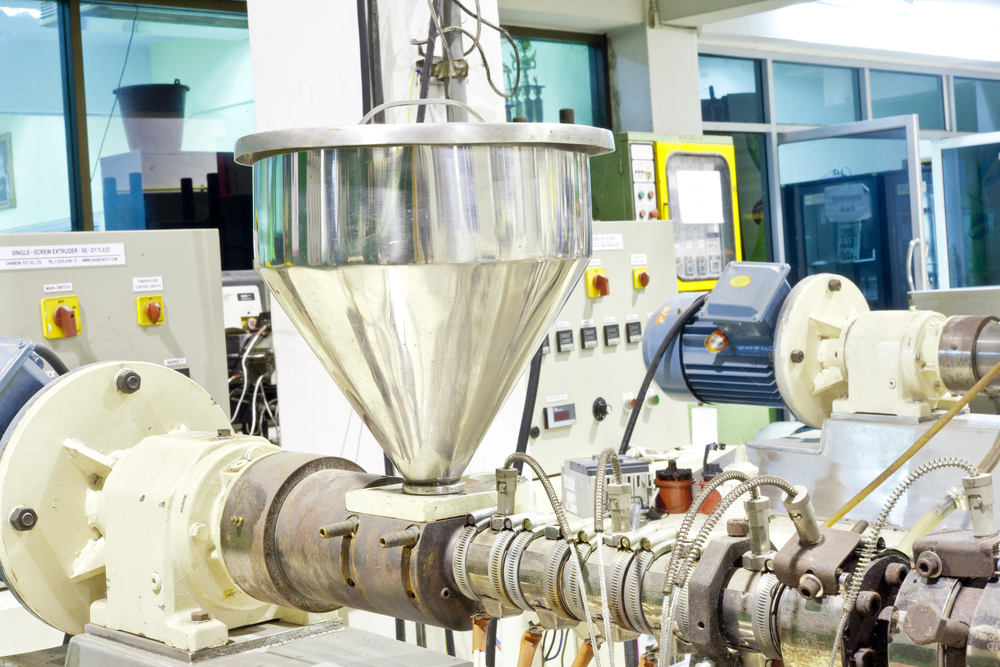
- Single Screw Extrusion Machines: These machines use a single screw to drive a cylinder that combines plastic granules and pushes them through a die. This results in the final product shape.
- Twin Screw Extrusion Machines: Twin screw extruders offer a range of screw diameters and configurations. These extruders are perfect for when special colors or attributes are needed (using additives) and can be used across all industries that use plastics.
What Goes into the Extrusion Process?
Plastic material is fed into an extruder hopper and gradually melted by the heat generated by the turning screws and heating components. The screws have three different zones to move materials along the extrusion process:
- Feed Zone: This is where the plastic material gets gravity-fed into the extrusion machine.
- Melting Zone: This is the section where the plastic materials are melted to the desired temperature.
- Metering Zone: This is where the last bits of plastic are melted and mixed to achieve a uniform temperature and composition before entering the cooling process.
Temperature Control
It is essential to maintain a consistent temperature inside the extruder’s barrel. Overheating can cause imperfections, so typically the barrel is heated gradually. The temperature is maintained with a series of fans and water-cooling systems before it’s extruded through a die mold.
Die Mold
A die mold creates one continuous profile that can then be cut into parts. Unlike injection molding, die molds allow your product to be continuously produced at the desired size. There are various types of dies that can be implemented into your process.
- Blown Film Extrusion: This process uses three types of dies: annular, spider, and spiral. As the molten plastic leaves the die, it forms a semi-solid tube and is cooled. Air pressure is used to expand the tube, which is then drawn upward, where the plastic is stretched over rollers.
- Film Extrusion is used when plastic sheets need to be thicker.
- Tubing Extrusion is typically used to produce products such as PE, ABS, Acrylic, and PVC Piping.
- Over Jacketing Extrusions are used in the outer layer of wires and cables. Two types of dies are used, tubing or jacketing, and pressure.
Contact Plastic Extrusion Technologies
As one of the top plastic extruders in Ohio, Plastic Extrusion Technologies provides high-quality plastic and tubing extrusions, as well as tooling. We are here to solve any extrusion challenge you might encounter by providing the highest-quality extruded parts on the market.
Plastic Extrusion Technologies can use many types of molten plastic in this process. Some of the most commonly used plastics include:
- Nylon
- Polyethylene, low and high-density
- Acrylic
- Polypropylene (different variations of polymer)
- Polycarbonate
- ABS
- PVC
- TPR
We can form these thermoplastic materials into strips, rolls, or coils depending on your needs. With special additives, you can choose from a wide array of colors when creating your final product, though color options may vary by manufacturer.
With over 100 years of experience in the plastic industry, we are happy to answer any questions you may have about plastic materials and extruded products. Contact us today for more information about our custom plastic extrusion capabilities and manufacturing process.